Watch the video below to see how we can designate certain streams of recyclables like mixed paper, white paper or plastic. You will see the green (designated stream) will be blown in a different direction to separate it from the rest of the waste stream (red).
Tuesday, November 12, 2013

“With or without legislation, we support cleaner emissions for our industry and, frankly, every industry"
New York Looks to Cut Emissions by Private Trash Haulers

Robert Stolarik for The New York Times
An Action Carting truck collecting cardboard in Greenpoint, Brooklyn. The company is one of New York’s largest haulers, with 80 trucks on city roads every day.
By WINNIE HU
Published: November 11, 2013
As aging garbage trucks rumble down the streets of New York, their fumes draw protests from residents and environmental advocates and raise concerns about asthma and other health effects.
The administration of Mayor Michael R. Bloomberg, which has made cleaner air a priority, has taken steps to modernize the city’s fleet of diesel-powered vehicles — including about 2,000 trucks used for picking up residential waste and recyclables — with newer, less-polluting models. Under a law the mayor signed in September, by 2017 at least 90 percent of these vehicles must meet the tougher emission control standards for diesel trucks that the federal Environmental Protection Agency set in 2007.
But those trucks are not the only ones on the streets. Now the administration wants to impose similar requirements on private haulers who dispose of the city’s commercial garbage and recyclables, as well as construction and demolition debris.
A new proposal would require about 8,300 private collection trucks to meet the same federal emissions standards by 2020, three years after the deadline for the municipal fleet. The proposal, which requires the approval of the City Council, is part of a larger package of revisions to the city’s air pollution control code.
Council officials said on Monday that they were reviewing the plan.
A report released last month by the New York City Business Integrity Commission, which oversees the private haulers, and the Environmental Defense Fund, a nonprofit group, projects that if no action is taken, the private trucks will emit a total of 1,368 tons of particulate matter and 23,198 tons of nitrogen oxides between 2013 and 2030. These substances, found in diesel exhaust, have been linked to respiratory and cardiovascular problems, smog and global warming.
The report projects that if private haulers retire their older trucks by 2020, particulate matter emissions would be reduced by 796 tons during that time period; it would be the equivalent of removing 341,829 cars from city roads every year between 2014 and 2030, the report said. Nitrogen oxides would also be reduced by 12,054 tons, or the equivalent of removing 862,704 new cars or 143,784 old cars from the roads every year.
Under the proposal, a refuse collection company would be given several options, including retrofitting older trucks with new engines that meet the 2007 federal emission standards, or replacing them entirely with new vehicles that do. Shari C. Hyman, the commissioner of the Business Integrity Commission, called the proposed mandate “a balanced approach that will help achieve the air quality goals of the administration without unfairly burdening private industry.”
The report, which was written by M. J. Bradley & Associates using city data, estimated that the overall cost of the proposal to the private haulers would be $484 million, on top of the $571.4 million they would be paying to replace trucks through normal turnover. However, commission officials said this figure could be significantly lower if trucks were retrofitted instead of replaced. The report also noted that with more new trucks and fewer old ones, savings on repairs and maintenance could be as much as $15.5 million.
Several companies’ representatives said they supported the proposal. “With or without legislation, we support cleaner emissions for our industry and, frankly, every industry,” said Ron Bergamini, chief executive officer of Action Environmental Group, the parent company of Action Carting, one of the city’s largest haulers with 80 trucks on city roads every day. He said he expected that half of those trucks would have to be replaced or retrofitted by 2020 — at a cost of about $270,000 for each new truck, and $25,000 to $35,000 for each retrofit.
But others said that while they supported the concept of reducing emissions, they remained concerned about the proposed legislation.
“Companies that collect waste and recyclables in New York City typically operate on very narrow margins and are limited as to their ability to raise prices,” said David Biderman, general counsel for the National Solid Waste Management Association, a trade group that represents more than 750 waste and recycling companies nationally, including 75 in the New York region. “This proposed legislation as well as other legislative proposals pending before the City Council are likely to increase carters’ costs significantly over the next few years if they are enacted.”
Patrick Hyland, executive director of the New York Metropolitan Trucking Association, an industry group for more than 50 heavy construction truck companies, said that he had initially resisted the proposal but that the commission’s willingness to adopt a 2020 deadline after considering an earlier date had made it “more palatable” to his members, who typically spend $160,000 to $190,000 on each new truck.
“I voiced my concerns about hitting them with something like this while some of them were still digging themselves out of the economic downturn, coupled with Hurricane Sandy,” Mr. Hyland said. “They need to prepare themselves financially.”
Jim Tripp, senior counsel for the Environmental Defense Fund, said he saw the proposal for private haulers as an “innovative” step in the Bloomberg administration’s efforts to improve air quality, which have included banning smoking in public places and phasing out the use of certain kinds of home heating oils. “I think it will have a citywide benefit since we all have garbage picked up and these trucks are everywhere,” he said.
A version of this article appears in print on November 12, 2013, on page A18 of the New York edition with the headline: Private Trash Haulers Are Now Focus in Quest for Clean Air.
Monday, September 30, 2013
We are proud to announce the launch of the Optical Sorter to improve the way NYC businesses recycle at the NYC GoGreen conference
New York, New York (September 26, 2013)
Joe Burke, Action
Environmental Group, Inc’s Director of Sales, publicly announced the
company’s recycling business, Action Environmental Solutions, opening of their
new state of the art recycling facility in the Bronx at NYC’s GoGreen
conference. This recycling center will ultimately change the way New York City
recycles. This new recycling facility called The Optical Sorter uses RedWave
optic technology to automate the recycling process and extract more waste from
landfills.
An optical sorter uses infrared technology to detect and separate all seven grades plastics, white paper from mixed paper and cardboard from the rest. This allows Action to extract higher quality recyclables out of the waste stream. This will also allow the customer to single stream their recycling. Single stream is when all recyclables go into one bin, no longer needing to separate. The Action Environmental Group philosophy behind the purchase of this vast and innovate recycling center is to lead NYC into the future of recycling.
“This technology allows us to extract recyclable material from what would otherwise be land filled. The goal of recycling has not changed but the method now has greatly improved.”- CEO of Action Environmental Group, Ronald S. Bergamini
You can view the video here: http://www.youtub e.com/watch?v=S-UzjL8GI4A
Thursday, September 19, 2013
Susan G Komen Walk
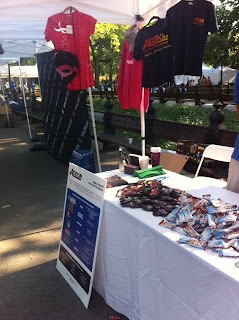
Action is a proud sponsor of the Susan G Komen foundation and every year we like to participate in the big NYC 5k Race for a Cure. This was especially exciting this year for the Action team as we asked our newest employees from the recent Interstate Waste Services acquisition to participate. Coming together for the first time and participating in a cause that effects us all in one way or another.
Some employees raced for the women in their family, a mother, sister or a friend. We are so proud of all the employees that participated in this years race. We got to have a lot of fun too!


Some employees raced for the women in their family, a mother, sister or a friend. We are so proud of all the employees that participated in this years race. We got to have a lot of fun too!


Thursday, August 29, 2013
Action a proud partner of CEO
.
Action is a proud partner of the Center for Employment Opportunity program. We believe in a brighter future for everyone. We believe in second chances and influencing public policy to give those chances. It affects us all.
Below is a video for The Center for Employment Opportunities' (CEO) proven model helps break the cycle of incarceration and saves taxpayers' money. This video was the result of a collaboration of MTV, Catchafire, and CEO. CEO-change that works.
Follow them on Twitter: @ceoworks
Like on Facebook: www.facebook.com/ceoworks
Wednesday, August 21, 2013
Builder Better Futures: Eco-Friendly Policies for Business and Individuals
Builder
Better Futures: Eco-Friendly Policies for Business and Individuals
By Sam Marquit
The world is growing, and knowledge is everywhere. People are
learning how to significantly reduce the amount of waste in their lives. In
today's world landfills have taken over, deforestation has increased and the
majority of people aren't recycling their waste. There are small and big things
that people and businesses can do to lessen the burden on Mother Earth. In my
work as a contractor, I've seen the green materials market grow to $116
billion. People are more concerned about the environment and what's going to
happen to our planet in just a few hundred years. The market is expected to
grow to $254 billion in 2020, which is hard to believe considering the amount
of pollution and waste that doesn't seem to be avoidable. Many practices that
are seen in a commercial setting can be implemented at the home front.
Millions of people go to Las Vegas every year. They come to this
desert specifically for the promise of a good time. The casinos, luxury hotels
and entertainment are some of the top reasons that travelers will cross-oceans
to visit. Still there is one hotel that is doing something different for the
environment. The Las Vegas Palazzo Hotel and Resort changed some of its policies
to be more sustainable and less wasteful. They included a watering system for
their landscapes that saves eight million gallons of water every year. This
system incorporates drip irrigation, moisture sensors and artificial turf
grass. Because of its sustainable features, the hotel was recently named the most
eco friendly hotel in America.
At home people can change the way that they use water for
landscapes and gardens as well. They can install drip irrigation systems, too,
or they can reuse gray water from showers and washer machines to water gardens.
There are also ways to collect rainwater. People can install low flow toilet
and tank less water heaters to lessen water waste throughout the home.
Recycling is one of the major ways that people contribute to
living green. They are able to reduce most aluminum, paper and plastic products
just with curbside pickup. There are also drop-off locations throughout the
city that will take other items like wood scraps, paint, hazardous chemicals
and much more. The ARIA hotel created a large sorting center to reduce its
waste. Now the hotel diverts 47 percent of waste from going to landfills, and
they send food scraps to local farms. Individuals are learning how to use
compost bins to use food scraps to fertilize their lawns and cut back on waste
as well. Another practice that is gaining popularity is “up cycling”. Instead of
throwing away old or worn out items, people are finding new and creative uses
for those items.
It is important that businesses and homeowners a like continue to
innovate the industry. Vegas sees millions of travelers each
year, staying at the various hotels and casinos. If a city like Las Vegas
can implement green infrastructure, so can a homeowner.
Sam Marquitfmarquitv.tumblr.com
Wednesday, August 14, 2013
Action honors Encore Community Service at Yankee Stadium


Action's Jenna DiBella honored Anthony Concepcion, Encore's Weekend Manager, at the Yankee Game last night (8/13/13).
Action has worked with Encore Community Services for the past 4 years inviting our employees to volunteer several times of year.
Encore Community Services, is an oasis’s in the heart of Manhattan
extending from 14th to 110 Street on the West side.
Providing support, meals, social services, and
housing for hundreds of homeless and low income elderly living in and
around this area; Providing elderly with whatever means possible, so
their remaining years can be lived in dignity and comfort.

Subscribe to:
Posts (Atom)